It’s been a weird past few weeks — the joy of spending Maui Comic Con driving around the Valley Isle with some good friends, the what-is-happening-to-our-country-ness of the general election, the devolution of my social media feeds from “must-read, and hey, here are a few news tidbits that are worth sharing in the blog, too” to GEEZ LOUISE ANOTHER POLITICAL OPINION POST I GET ENOUGH OF THIS READING THE WIRE SERVICE FEEDS AT WORK KILL IT WITH FIRE.
There have been a number of things to talk about in the this blog, too. I just haven’t had the time/energy to get around to writing them up. Weird thing is, I’ve seen similar sentiments echoed by some Facebook friends over the past few days or so. Real Life has just been sucking our creative juices dry, and that’s just … unfortunate.
But, well, time marches on and events keep happening. And sometimes you just have to grit your teeth, bear down and get stuff done, no matter how small a step it may be. So to get the ball rolling once again, here are some quick news tidbits. I know there’s been quite a bit going on with Con-athon 2017 developments; I’m working on another post that’ll address those (hopefully) somewhat sorta soonish.
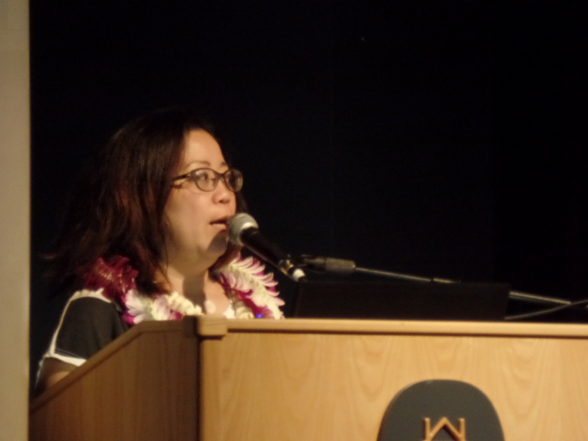
Eighty-two pictures from this event, and this was the only decent shot I could get of Deb. I feel like I failed somehow. Photo by Jason S. Yadao.
Tidbit no. 1: Remember that manga talk Deb Aoki gave at the Honolulu Museum of Art back on Oct.28? Here’s the complete video of that discussion, courtesy of Stephen Salel at the museum. If you ever wanted to know more about Deb’s career arc, this is definitely the place to do it.
Tidbit no. 2: Spirited Away is returning to theaters nationwide on Sunday and Monday to mark its 15th anniversary, and it’s bringing a special treat for die-hard Studio Ghibli fans: the first-ever North American screenings of Ghiblies Episode 2, a 25-minute comedic short about what goes on at an animation studio that looks a lot like Studio Ghibli itself. Check it out locally at noon Sunday (dubbed) or 7 p.m. Monday (subtitled) at the Regal Dole Cannery theaters. Tickets are available on Fandango for $13.09 general, $10.47 children 11 and under.
Tidbit no. 3: It’s the final (official) jam of the year for Comic Jam Hawaii, the group of collaborative cartoon artists, and they’re road-trippin’: They’re headed over to the Windward side and Kailua Public Library, 239 Kuulei Road, from 1 to 4 p.m. Saturday. Visit www.facebook.com/groups/ComicJamHawaii(Facebook login required).
Tidbit no. 4:MiniQ, that outpost of anime goodie happiness in the middle of Aiea, is opening a second branch Friday, Dec. 9, at 95-1057 Ainamakua Drive in Mililani Mauka. There’s going to be food and giveaways at the grand opening, too! Seeing as how (a) this makes MiniQ many miles closer to Otaku Ohana Central out here in Mililani Town, (b) it’s right next to the Sugar Coated Hawaii bakery and (c) it’s just a short walk away from Starbucks, Taps ‘n’ Apps, Wing Stop and Dragon’s Lair, my wallet is already weeping.
And last but certainly not least: Stan Sakai, who’s been chronicling the adventures of the rabbit ronin Usagi Yojimbo all these years, is coming back to Honolulu for a signing session from noon to 2 p.m. Saturday, Dec. 10, at Other Realms (1130 N. Nimitz Highway, in the back of the Nimitz Center) In honor of Stan’s appearance, the store is selling a special 11×17 Usagi print, limited to 200 copies, for $30 each. Here’s what it looks like.
If you’re drooling right now, first of all, here’s a napkin, that’s kinda gross. And second of all, you can order one for yourself by calling 596-8236, stopping by the store or filling out the online form at www.other-realms.com/stan-sakai-2016.html You can even pick it up on the day of the signing or have it shipped.
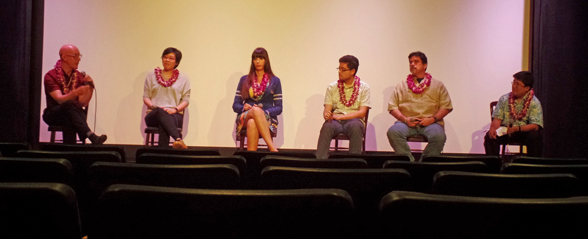
The Honolulu Museum of Art’s Stephen Salel, left, leads a panel discussion with artists Audra Furuichi, Jamie Lynn Lano and Brady Evans; Kawaii Kon senior administrator Roy Bann; and some dorky blogger boy who probably should’ve moved his chair closer so he could see better. Photo by Diane Masaki.
On Oct. 7, your friendly neighborhood otaku blogger joined artists Brady Evans, Audra Furuichi and Jamie Lynn Lano, as well as Kawaii Kon senior administrator Roy “Buma” Bann, for “Manga in Japan, Hawai‘i, and Throughout the World,” a series of short lectures and a roundtable discussion at the Honolulu Museum of Art. Hosted by Stephen Salel, the museum’s Japanese art curator, the event was held in conjunction with the ongoing exhibit “Visions of Gothic Angels: Japanese Manga by Takaya Miou,” on display through Jan. 15.
A handful of people showed up. Some weren’t even friends or spouses of the speakers! And whoever was there learned a fair amount about manga and our perspectives on the industry. (As far as I could tell, no one fell asleep during the presentations, which was also a big plus.) Thanks to everyone who turned out!
But maybe 4 p.m. on a Friday didn’t really fit into your schedule. It’s OK; we have you covered. I’m pleased to announce that about 90 percent of the day’s presentations have now been posted on YouTube. Sadly, Stephen told me this morning that the other 10 percent — that closing discussion, a picture of which is shown above — isn’t available due to some serious audio problems.
My presentation predominantly features my slides, which is probably a good thing, considering I was kinda squinting and tearing up during a good chunk of it. (It was probably a combination of nerves and some wayward dust particles.) The videos are conveniently broken up by speaker.
Enjoy!
Part 1: Introduction by Stephen Salel
Part 2: “The Origin of Manga” by Stephen Salel
Part 3: “What is Manga?” by Audra Furuichi
Part 4: “Working as a Manga Artist in Japan” by Jamie Lynn Lano
Part 5: “Rise, Fall, and Rebirth of the Manga Industry in the U.S.” by me!
Part 6: “Organizing Manga and Anime Conventions in Hawaii” by Roy Bann
Part 7: “Crossing Cultures: The Art of Manga in Hawaii” by Brady Evans
West Hawaii coastline as seen from the Mauna Lani Bay Hotel and Bungalows, home to HawaiiCon 2016. Photo by Jason S. Yadao.
Welcome to the all-new, 100-percent-less-newspaper-affiliated Otaku Ohana! As always, I’m your friendly neighborhood otaku blogger, Jason Y.; over there playing Tsum Tsum (both regular and Marvel varieties!) and likely racking up three or four times the scores and coins I’m capable of garnering is longtime Tag-Team Partner in Fandom Wilma Win. The usual cast of characters and running gags are sticking around as well. (Aiea Library still does have plenty of parking, by the way.)
Please pardon our dust as we get settled and figure out the new toys we get to play with now that we have full control over our design and content. For starters, I think this part of the post is where I’m supposed to stick multiple garish “website under construction” animated GIFs.
(We are still under late-’90s web design protocol, right? No? Dang.)
In any case, we’re trying to look at and implement cool new features whenever we can find them and figure out what they do. You’ll notice one of those new features in the sidebar listed to the right (if you’re reading this on a computer, anyway) under “What’s Goin’ On?”: The Ota-cool Incoming Calendar is now an actual standing calendar. There are a number of events already populating it, from the imminent upcoming screenings of Shin Godzilla through Anime Ohana next October, and I’ll be updating and adding descriptions to the calendar as the information comes in to Otaku Ohana Central. (I’ll still be highlighting a few upcoming events here and there in blog posts, too.) You can find out a little bit about this blog in that section, too.
We’ve got a nice, spiffy new header image in the works, too. Hopefully we’ll be able to reveal that in the next week or so.
Now comes the hard part: figuring out how to fill this new space with the quality content you’ve come to expect from us over the years. Shouldn’t be a problem, of course. But new adventures always come with some degree of uncertainty, right?
This edition of Otaku Ohana is brought to you by two pens, an apple and a pineapple.
Because if I have to write this post about all the otaku activities going on at the Honolulu Museum of Art this month while I’m thinking about how there’s an pen, and there’s an apple, and UNH, now there’s an APPLE PEN, then I’m sure as heck going to have you, dear reader, stuck with that thought, too.
(It could’ve been worse. The Otaku Ohana Anonymous Director of Forced Social Interaction left me with the earworm of Pentatonix’s “Perfume Medley” during all of HawaiiCon a few weeks ago. You try walking anywhere having “Spending all, spending, spending all my time / Loving you, loving you foreeeever” lodged in your, lodged in your brain foreeeever.)
Even the exhibit entrance sign looks pretty. Photo by Jason S. Yadao.
But I digress. There’s a lot going on at the art museum, and much of it is tied in with a major manga exhibit: “Visions of Gothic Angels: Japanese Manga by Takaya Miou.” The exhibit, ongoing through Jan. 15, is curated by Stephen Salel, the man who also assembled “Modern Love: 20th-Century Japanese Erotic Art,” the 2014-15 exhibit that brought manga artists Erica Sakurazawa and Moyoco Anno to Honolulu. From the exhibit description:
Takaya’s artwork explores themes of femininity and female identity through fantastic imagery originating from a wide variety of artistic traditions: Italian Renaissance portraits of Christian martyrs, the intricate Art Nouveau style of British illustrator Aubrey Beardsley (1872–1898), the surreal puppets of German sculptor Hans Bellmer (1902–1975), and the whimsical street fashion of Harajuku district in Tokyo.
In addition to an overview of the artist’s 25-year career, Visions of Gothic Angels: Japanese Manga by Takaya Miou focuses upon two anthologies, The Madness of Heaven (Tengoku kyō, 2001) and Map of Sacred Pain (Seishō-zu, 2001). Illustrations and short stories from these publications will be presented in a variety of formats: original drawings, printed books (tankobon), large-scale wall graphics, and digital works that visitors can read from cover to cover on iPads installed in the gallery.
Here are a few shots I took at the opening night reception in August that give you an impression of how it all looks.
Here’s the entrance to the exhibit. On the near wall, you can see some of Takaya’s art; the far wall contains several of her manga pages. Photo by Jason S. Yadao.An entire wall is devoted to displaying doujinshi Takaya has published over the years. Photo by Jason S. Yadao.“After a Poem by Tsukamoto Kunio” (1998) is one of Takaya’s works on display. Photo by Jason S. Yadao.
While Takaya won’t be appearing at the museum during the exhibit’s run — I understand she’s quite reclusive — there are those aforementioned events that the museum’s hosting. I was too busy to mention anything about last Saturday’s screening of Miss Hokusai, but here are some pictures an attendee, who wished to be identified as “fuzZz ,” passed along to me.
Artists hard at work at a reception held before the screening of “Miss Hokusai” Oct. 1. From left are Jon Murakami (with FIGHTING SPIRIT HEADBAND~!), Michael Cannon, Kaci Horimoto and Tara Tamayori.A fan drawn by Kaci Horimoto. It sold at silent auction for $50. (A certain blogger dork may have bid on it via proxy and won it.)One of the fans drawn by Michael Cannon.
From 4 to 5:30 p.m. Friday at the Doris Duke Theatre, there’s going to be a roundtable discussion, “Manga in Japan, Hawai‘i, and Throughout the World,” featuring artists Brady Evans, Audra Furuichi and Jamie Lynn Lano; Kawaii Kon senior administrator Roy “Buma” Bann, and some friendly neighborhood anime/manga/comic blogger dork who may be revealing some big news about the future of Otaku Ohana during his portion of the discussion. (It’s pretty exciting!) Come get a quick primer on the industry, learn about where we draw our inspirations from, and hear why 60% of the panel adores homespun slice-of-life comedies.
Another lecture at 4 p.m. Oct. 28 will feature Bento Box artist, former manga.about.com curator and all-around U.S. manga community sempai Deb Aoki. In her talk, “Making a Living in Manga: Bento Box and Beyond,” she’ll discuss her artistic career, how she got interested in manga and the struggles of contemporary manga creators. Both her talk and our panel discussion are free. so swing by, enrich your manga fandom a bit and avoid a good chunk of what’s bound to be horrible afternoon rush-hour traffic.
Last but certainly not least, there’s the ongoing Japanese Cinema spotlight, which I’ve talked about in this space before (along with several other movies that are coming up in the next few weeks!). As a reminder, here are the remaining anime on the schedule, featuring a tribute to late director Satoshi Kon:
>> Millennium Actress, 1 p.m. Sunday, Oct. 23, and 1 and 7:30 p.m. Thursday, Oct. 27
>> Paprika, 7: 30 p.m. Sunday, Oct. 23, and 1 and 7:30 p.m. Tuesday, Oct. 25
>> Tokyo Godfathers, 4 p.m. Sunday, Oct. 23, and 1 and 7:30 p.m. Wednesday, Oct. 26
Tickets are $10 general admission, $8 museum members.
The art museum and theater are located at 900 S. Beretania St.; admission to the museum is $10, with free admission every first Wednesday and third Sunday of every month. For more information, visit honolulumuseum.org.
Beetle, Kubo, and Monkey emerge from the forest and take in the beauty of the landscape in “Kubo and the Two Strings.” Courtesy Laika Studios/Focus Features.
It was on my first day back at work after my recent Comic-Con Honolulu vacation that I got the offer from our features editor, Christie Wilson: Would I be interested in doing an interview with Travis Knight, director of Kubo and the Two Strings?
Was I ever.
I mean, it’s not every day that your friendly neighborhood anime/manga/cartooning blogger gets handed an opportunity to pick the brain of someone tied in with a major national theatrical release. And not just any someone; this was Travis Knight, CEO of Laika, the stop-motion/computer animation studio behind Coraline, Paranorman and The Boxtrolls, and the son of Nike founder Phil Knight. That’s a resume that makes someone a virtual lock on my “people I will talk to no matter what, as long as the offer remains on the table” list.
That “no matter what” clause did come into play a few times. There were a few missed connections, and the publication venue shifted from print to online. But it finally came to pass that last Thursday — the morning after I attended the Hawaii premiere of Kubo — I got to spend 15 minutes on the phone with Knight himself. And … wow. If you had told me 10 years ago that I would be talking about manga and Japanese culture with an animation studio CEO and director of what would turn out to be the No. 4 movie in the nation at the weekend box office, younger me probably would have freaked the freak out.
Kubo’s certainly a great movie over which to start a conversation. The titular character is a boy who spends his days as a storyteller in a Japanese fishing village, crafting fantastic tales and enlivening origami pieces with his trusty shamisen, and his nights atop a peak, caring for his ailing mom who slips in and out of a trance that seems to be tied in to the rising and setting moon. When Kubo accidentally unleashes a vengeful spirit upon the village, it’s up to the boy, a monkey charm brought to life and a quixotic insect samurai to take it out … and perhaps solve the mystery of what happened to his fallen father along the way. It’s the best movie I’ve seen this year to date, full of Laika’s trademark eye-popping animated charm (be sure to stick around for the end credits for a cool behind-the-scenes shot!) and if you haven’t seen it yet, you should correct that as soon as possible.
The film marks Knight’s debut as director, the natural next stop in a 20-year career in animation that’s seen him serve as a production assistant, scheduler, coordinator and producer, taking ideas from conception and development all the way through completion; work as a stop-motion and computer animator; and run a major animation studio. During that time, there was always a part of him that wanted to direct a feature — “I think it’s sort of a cliche that every animator wants to direct something, and so I guess I am a cliche,” he said.
It was just a matter of timing.
“Those early days at Laika, we were trying to get the place up and running, so a lot of the energy early on was just making sure that the place could function,” Knight said. “So I’ve been involved heavily on every single film that we’ve done. But once I felt like a) the company was in decent shape, and b) I’d have enough experience that I could bring to bear to direct one of these things properly, and c) that I had enough of an emotional connection with it, that I could honor the story in the best way and bring a unique point of view and perspective to it, all of those things had to align before I was ready to take something on. And on this project, it did.”
“Kubo and the Two Strings” director Travis Knight works with Kubo on the “Kubo’s Village” set. Courtesy Laika Studios/Focus Features.
The project featured the convergence of several factors. Directing drew upon every experience Knight had in the industry to date — “It required an animator’s eye for detail and attention, the ability to focus on the granularity of something,” he said. “But at the same time, to not lose sight of the bigger picture.” (Even with that, it was the hardest thing he had done in his career, he said.) The story of Kubo’s epic journey is a callback to the kinds of fantasy epics Knight enjoyed during his childhood. Sometimes his mom told him those stories, like Kubo’s mom shares with her son in the movie. They were tales woven by legends of the genre — L. Frank Baum, C.S. Lewis, Lewis Carroll. J.R.R. Tolkien was a particular favorite, perhaps owing to the fact that Knight’s mom was reading Lord of the Rings while pregnant with him and during postpartum recovery.
And then there was the Japan factor. When Knight was 8, his dad let him tag along with him on one of his business trips there. For a kid who’d grown up in Portland, Ore., going to Japan was a life-changing experience.
“From the moment I set foot in Japan, it really was like I’d been transported to another world,” Knight said. “It was so incredibly different, but also just beautiful and breathtaking and almost otherworldly. It was so completely unlike anything I had ever experienced growing up in Portland, everything from the food to the style of dress to the music and the architecture and the art and the movies and the TV shows and the comic books. Everything about it was so totally different from anything I had ever seen before, and I was enthralled by it.
“It really was a revelation for me, and I came back home with a backpack full of manga and art and little artifacts from my journey in Japan, and it really was the beginning of a lifetime love affair that I’ve had with this great and beautiful culture.”
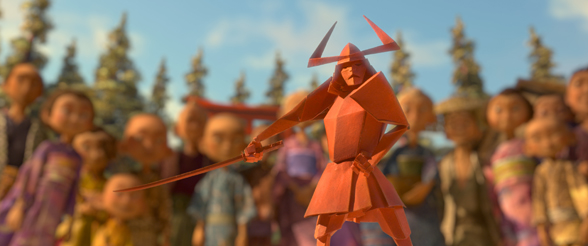
Kubo’s story brings magic to life as Little Hanzo, an enchanted origami piece, takes center stage. Courtesy Laika Studios/Focus Features
Knight cited the samurai-and-son epic Lone Wolf and Cub and the missions taken on by the titular stoic assassin of Golgo 13 as two series that made an impression on him, the former having a huge influence on Kubo’s development. Having grown up on a steady diet of American and British comics, the artistic and storytelling style of manga appealed to him, even if it was all in Japanese and widespread American familiarity with manga’s right-to-left, back-to-front format was still more than a decade away at that point.
“I think that’s the mark of how extraordinary these storytellers were that it transcended language,” he said. “It was something that could speak to you, even if you couldn’t speak the actual language.”
The work of two of Japan’s most revered filmmakers, Akira Kurosawa and Hayao Miyazaki, also helped shape Kubo. Knight sees Japan as the birthplace of the modern cinematic epic, with Kurosawa — a “pictorial Shakespeare,” as labeled by Steven Spielberg and affirmed by Knight — being the director who led the way.
“He was certainly an aesthetic muse for the film, just in terms of how he made films — composition, cutting, lighting, movement, staging,” Knight said. “You could basically take any frame of a Kurosawa film and put it on a wall, I mean, it’s that gorgeous. They look like paintings. I don’t think there’s a filmmaker alive that hasn’t been directly or indirectly influenced by Kurosawa. I mean, you could just look at all of the things … Yojimbo was a huge influence. I mean, I saw Sergio Leone’s Fistful of Dollars and loved it before I even knew that Yojimbo existed. But then of course you find out later that it’s a remake of a Kurosawa film, as so many Western films are.”
There are a number of nods to the director’s work throughout Kubo. Kubo’s dad is modeled after frequent Kurosawa muse Toshiro Mifune, and Kubo’s broken home is a callback to the ruined fortress in Rashomon. Several themes that ran through Kurosawa’s films are also explored here — “the exploration of humanism, of existentialism, the role of the ideal, what it means to be a family, what it means to stand up to family sometimes to make the world a better place,” as Knight put it.
As for Miyazaki?
“I think that most modern animators … worship at the altar of Miyazaki,” Knight said. “I mean, I love his films, they’re just exquisite. Everything from My Neighbor Totoro to Spirited Away, Princess Mononoke, Kiki’s Delivery Service. I mean, they’re all just lovely films that are so different from each other.”
Knight applied two elements common in Miyazaki’s films to Kubo. The first features characters that act in shades of gray rather than black and white. Anyone who’s seen the movie might be nodding in agreement here over the character arcs, particularly when it comes to Kubo’s scene in the graveyard and the moment when the Moon King reveals his motivations.
“I love how Miyazaki approaches films and protagonists and antagonists where there are shades of gray all throughout his filmmaking,” Knight said. “Even the villains are not pure evil; oftentimes they’re misunderstood or they have a different perspective or they have shades of light within them. And then the heroes are not completely noble; they have problems of their own. I just love that approach, that there’s empathy toward people who may be misunderstood.”
Kubo (voiced by Art Parkinson from “Game of Thrones”) takes in the scenery below as he sets off on a journey to his village. Courtesy Laika Studios/Focus Features.
Those characters dwell in a Japan that certainly feels like Japan, even if it’s not a direct reflection of any one time in particular. Knight compared it to Miyazaki’s fascination for Europe and how it’s depicted in his movies, rendering the continent more as an impressionist painting rather than a photograph or a documentary.
“Our version of Japan, it’s a period fantasy, it’s not a photograph,” Knight said. “Even though we do incredible, extensive research into regional and historical history, it is a period fantasy. But we want to make sure that our fairy tale has one foot in the real world.
“And so, very much like Miyazaki is, the prism he applies to Europe, that’s what I wanted to do to Japan, is to effectively make an impressionist painting of Japan so that we can capture the feeling, the experience that I had when I was a kid exposed to Japan for the first time, this wondrous, beautiful, magical, breathtaking place. I wanted to try to infuse the film with that kind of spirit, and hopefully it does that.”
So as we head into the movie’s second weekend in theaters, why see Kubo (which I’d highly recommend you do) or see it again (which I’d highly recommend you do as well)? It’s hard for me to summarize it without leaving something out, so here’s his complete response:
“On one level I think it operates as just a big, sprawling epic fantasy. It’s a lot of fun, there’s action, there’s adventure, there’s humor, there’s heart. I think what I love about the movie more than the beauty of the images is what’s underneath it. I mean, it is cinematic pageantry, there’s a lot of glorious things to the whole, it does dazzle the eye. But I love the strong beating heart that it has underneath it all. That really gets to the core issue and the core themes that we explore in the movie. Fundamentally it’s a film about loss, it’s about grief. It’s about things that are typically shied away from in films geared toward family, how we confront and deal with significant loss and death and what grief can do to us.
“But at the same time it’s also a film about healing. I mean, we explore this, we have this motif of scars in this movie, where every single central character in the film is physically scarred in one way and emotionally scarred as well. And you know for Kubo, he’s ashamed of his scar. He combs his hair not because he’s trying to be a cool goth kid, he covers his eye not because he wants to have an awesome hairstyle, but because he’s ashamed of what his hair is covering. And he believes like so many of us believe, that a scar is a symbol of injury. But as we go through the film, we also get to this other notion, come through the other side, that while a scar is a symbol of hurt, it’s also a symbol of healing, after we’ve been ripped to shreds, the scar is something that makes us whole. So by the end of the film, he’s no longer ashamed. He’s an open wound who’s been made whole by this whole experience.
“So fundamentally it’s an exploration of loss, but also of healing. It’s a meditation on compassion and forgiveness and empathy, which I think in this fractured world that we live in, we could all use a bit more of.”
And that was where our conversation ended … or at least it would have been, had the studio’s PR rep not mentioned that I had time for one last question. So I asked him: “You have the opportunity to sit down with Kurosawa and Miyazaki and talk to them about whatever you want. What do you talk about?”
Knight paused for a moment.
“Oh my goodness,” he said. “I don’t even know if I can answer that! I mean, where to begin? They tell you never meet your heroes, never meet your idols, that you’ll be disappointed.”
He went on to say that he’d been fortunate enough to have the opposite experience in working on Coraline with two people he admired: author Neil Gaiman — “a master and a genius who just oozes genius out of his pores” — and director Henry Selick, who also directed The Nightmare Before Christmas and James and the Giant Peach.
“But that was a working relationship,” Knight said. “If I met them as a fanboy for the first time, I would probably be stricken and not be able to say a word. I don’t know … I really don’t know how to answer that question. I wish I had a clever, quippy response, but it’s … when you’ve admired someone’s work for so long and you’ve been drinking it your entire life, the notion of being in the same room and talking with those guys, I don’t even know where I’d begin.”
And that was my conversation with Travis Knight. Looking back on the experience a week later, I’d have to say I felt like he would in meeting his filmmaking idols — total fanboyish glee threatening to turn me into a blubbering pile of squee-ing goo. Throughout this writing cycle, I felt a sense of “OHMYGODOHMYGODOHMYGOD … OK, let’s get to work … OK, interview’s done OHMYGODOHMYGODOHMYGOD.” I hope this post captured the essence of what was really an enlightening chat with him.
Oh yeah, and go see Kubo and the Two Strings. Sometime. Definitely.
Congratulations, dear otaku! You’ve managed to survive the first four months of the year. Here, have some cookies … err, comics.
Indeed, with all that’s been happening in the real world and its cascade of bad news, we’ve made it to the annual national celebration of comic book culture, Free Comic Book Day. On Saturday, various comic shops and libraries will be giving away a wide range of comic books. Some will even be hosting special events. It’s a tradition that’s run annually since 2002, and while some of the stores locally have changed over the years, the concept remains the same: give away comic books; expose readers to a wide range of series; get people into stores to peruse what’s available. Put another way, it’s like a comic Christmas.
The books this year run the gamut from summer blockbuster source material (Avengers, Suicide Squad, Captain America) to pop culture icons (Archie, Doctor Who, Strawberry Shortcake, Sonic the Hedgehog) to cool little niche titles that you might not recognize now but might just end up being the next series that you slavishly follow every month. Manga fans, the books you’ll want to look for are Kodansha Comics’ Attack on Titan Anthology preview and a pair from Viz, Pokemon Pocket Comics and the One-Punch Man/My Hero Academiacombo sampler. You can find a complete list of what’s available here; just remember that the sites celebrating Free Comic Book Day rarely, if ever, have every book in stock. Don’t forget to patronize your local stores and stick a few dollars in their cash registers, too; while the books are free to readers, they aren’t for the stores.
So where can you go? With six stores and 14 libraries on Oahu and a smattering of locations on the neighbor islands, you certainly have options this year.
Comic book stores
The biggest celebration in the state looks to be at Other Realms (1130 Nimitz Highway, suite C-140) in Iwilei, with cosplayers, gifts for children in cosplay, discounts, door prizes and a FCBD Spongebob Squarepants pin for the first 100 customers. Special guests include Free Isabelo, founder of Live Free Die Free (LFDF) Comics and creator of The Contraptor; Gary Turner, a local TV commercial producer and creator of I, Mage; and the creative team behind Kipaku Kai. Midweek cartoonist, Cacy & Kiara creator and Pepe the Chihuahua kalbi wrangler Roy Chang’s also going to be there, drawing caricatures of people as Funko Pop figures. You know, kind of like this.
… and yes, that is your friendly neighborhood otaku blogger in the upper left corner with a convention badge, funny cosplay hat and phone running Ingress at the ready. I love it.
Dragon’s Lair (95-1840 Meheula Parkway, suite E-10) in Mililani will be hosting artists Jon Murakami, Michael Cannon and Reid Kishimoto, who’ll be doing sketches throughout the day and handing out bookmarks drawn by Comic Jam Hawaii members. I don’t think I’ve ever spotlighted Reid’s artwork in this space before, so here, have some Disney Princess bookmark samples drawn by him.
Over on Hawaii island, Enjoy Comics (45-201 Pohaku St.) is teaming up with Hilo Public Library and using the day as an opportunity to promote literacy through comics. Comics will be available at the store and at the library, and the library has a special display showcasing local and national comics that will be up all month.
Also giving out comics: Choice Comics (98-1268 Kaahumanu St., suite 104) in Pearl City; Westside Comics and Games (590 Farrington Highway, #538) in Kapolei; and Collector Maniacs (3571 Waialae Ave., suite 102A) and Gecko Books (1151 12th Ave.), both in Kaimuki. Maui readers can visit Maui Comics & Collectibles (333 Dairy Road, suite 102) in Kahului.
Various cosplayers and one Face of Hawaii Ingress ™ gather for a picture at Free Comic Book Day 2015 at Aiea Library. Photo by Jason S. Yadao.
Libraries
If getting to a comic book store is too much of a haul for you, your neighborhood library might be able to help. Participating libraries include Aiea, Aina Haina, Hawaii Kai, Kailua, Kalihi-Palama, Kapolei, Manoa, McCully-Moiliili, Mililani, Salt Lake-Moanalua, Waianae, Waikiki-Kapahulu, Waimanalo and Waipahu on Oahu; Princeville on Kauai; Kahului, Kihei, Lahaina and Makawao on Maui; the Lanai Library booth at the Saturday Market in Dole Park on Lanai; and Hilo, Kona and Thelma Parker on Hawaii island.
The libraries will have Comic Jam Hawaii bookmarks, and they’ll have a selection of the following comics:
Archie #1
Assassin’s Creed
Avengers #1
Bongo Comics Free-For-All (Simpsons)
Boom! Studios Summer Blast (featuring Mouse Guard, AdventureTime and Lumberjanes)
Captain America #1
Dark Horse All-Ages Sampler (featuring The Legend of Korra, How to Train Your Dragon and Plants vs. Zombies)
Suicide Squad #1
DC Super Hero Girls
Doctor Who: Four Doctors Special
Grumpy Cat
Pokemon Pocket Comics
Dark Horse Serenity/Hellboy/Aliens
Spongebob Freestyle Funnies
Strawberry Shortcake #0
In addition, cosplayers from the 501st Imperial Legion, Rebel Legion Hawaii and Hawaii Cosplayers Guild will be showing up at Aiea, Aina Haina, Kapolei, Manoa, Mililani, Salt Lake-Moanalua, Waikiki-Kapahulu, and Waipahu libraries on Oahu, Makawao on Maui and Thelma Parker on Hawaii island. Lawrence Muleh, a Maui teacher, artist, illustrator, creator, and children’s book author, will be teaching a drawing workshop at Makawao Library at 2 p.m. But the luckiest library in the state has to be Kihei, who’ll be hosting comic artist James Silvani from 10 a.m. to 1 p.m. Among his credits: artwork on Darkwing Duck and Animaniacs comics. Seeing as how those are two of my favorite series ever, I am so jealous of you right now, people of Kihei.
If someone were to write a book about local otaku culture — don’t look at me; I’ve already written my one book of a lifetime, and I doubt I’ll ever have enough free time to properly update that one, never mind writing another one — one of the chapters would have to be about how we manage to accumulate so much stuff. Plushies, figures, statues, toys, video games, assorted show merchandise, books, CDs, DVDs, Blu-rays — you name it, we all have some sort of stash stored somewhere. Some of you may be sighing over how you have waaaaaaay too much; others may be lamenting about how you don’t have enough. For those of you in the never-ending pursuit of managing and accumulating more stuff, these next two weekends — along with the ongoing 20%-off sale at Book Off Ala Moana that I talked about in my last post — offer several chances to score some sweet bargains.
One sale is part of the 26th Annual Hawaii Collectors Expo, happening Friday through Sunday at the Blaisdell Exhibition Hall. Saturday (from 9 a.m. to 6 p.m.) and Sunday (10 a.m. to 4 p.m.) are what matter for our discussion, as that will be when a bunch of people like tag-team partner in fandom Wilma J. and I will be selling off surplus parts of their collections at … well, depending on where you go, it’s either the Anime Swap Meet or the All-Genre Swap Meet, presented by Kawaii Kon and Comic-Con Honolulu, respectively. And when I say “a bunch of people like us,” I really do mean to say that in the interest of full journalistic disclosure, Wilma and I have purchased a space where we will be selling things. Here is a preview of my stuff.
And here is Wilma’s.
… she always was more organized than me. (You can probably expect many more DVDs and even a few Blu-rays from me, for starters.)
Want to join us in selling? As far as I know, there are a few spaces remaining. One 5-square-foot space costs $25, with a maximum of two spaces shared by two people; the cost remains the same regardless of whether you apply to sell for one or both days, so if you can spare an entire weekend, by all means do so. Deadline for applying is midnight Thursday, check out the rules and apply at kawaiikon.com/anime-swap-meet/ or comicconhonolulu.com/all-genre-swap-meet-feb-20-21-2016.
If you’re in the market for buying, we love you! Please buy our stuff. (And everybody else’s, too, of course.) Kawaii Kon representatives will be on hand to sell three-day general-admission passes to this year’s show for $50 — $5 off the current online price! Keep in mind that admission to the Collectors Expo is $5, but if you present your badge from last year’s Kawaii Kon or Comic Con Honolulu at the box office, the cost drops to nothing.
The other sale worth noting here is the Nerds’ Garage Sale, which has proven to be the hottest ticket in town for sellers in recent weeks. (For the record, there is no more space for sellers, so stop asking on the Facebook page already.) Organized by cosplayer extraordinare Leah Rose, the sale will feature about a dozen self-described “cosplay nerds” selling off their extra supplies, costumes and other things. You can also check out Other Realms’ sizable collection of comics, games and other happy nerdy collectibles for sale as well. That’s happening from 3 to 7 p.m. Feb. 27 at the store, which is at 1130 N. Nimitz Highway, suite C-140. (It’s actually not visible from the highway; you have to go behind the buildings with New Eagle Cafe on one end and AAA Hawaii on the other end to find it.)
Elsewhere around town
Aiea Library Polar Bear Cafe & Friends Anime Club: Every month, I joke with young adult librarian Diane Masaki that she ought to change the name of the Anime Club to the Polar Bear Cafe & Friends Club, seeing as how the screening schedule for the past few months has consistently been two episodes of the 2012-2013 anime followed by two more episodes of something else. (This month’s “friends” are the ship-gals of KanColle.) This month didn’t garner much of a reaction, probably because Diane, the Face of Hawaii Ingress (tm) that she is, is really really close to becoming a max-Level 16 agent. The friendly neighborhood anime/manga/cartooning blogger in me is cheering her on, while the Enlightened side of me wants to put AXA Shields on every portal in Pearl City and Aiea. But I digress. At the library, 99-374 Pohai Place, where, yes, there’s still plenty of parking. For more information or to RSVP, call 483-7333 or email aiealibraryanimeclub@yahoo.com. 3 p.m. Saturday.
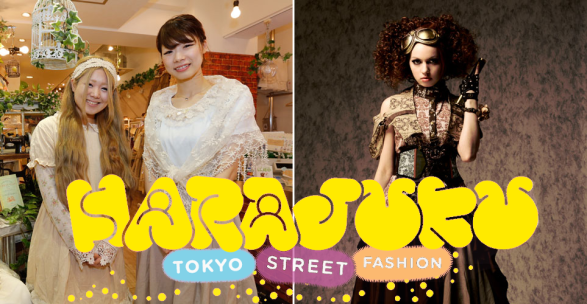
Mori & Steam: Steampunk Family Sunday: If you haven’t had a chance to check out the “Harajuku: Japanese Street Fashion” exhibit at the Honolulu Museum of Art yet, by all means try to stop by before it closes April 3; it’s a fascinating snapshot of contemporary Japanese fashion trends. And with the museum’s Family Sunday coming up, you can swing by to see it absolutely free, and enjoy some activities and entertainment, to boot. Kids can make a set of steampunk goggles at one station, at another, visitors can make their own Harajuku- or steampunk-inspired pins. Roy Chang, MidWeek cartoonist, Cacy & Kiara author and Pepe the Chihuahua’s kalbi feeder, will be doing live sketches of Harajuku fashion models from noon to 3 p.m., and featured bands include Hook + Line and Gypsy 808. There also will be a complimentary shuttle running between the museum and Spalding House, so you can check out the exhibits at both locations. Oh hey, and before or after you go, perhaps you might like to visit a certain Collectors Expo with an Anime/All-Genre Swap Meet going on down the street? *hint hint* *wink nudge* The museum’s at 900 S. Beretania St. 11 a.m. to 5 p.m. Sunday.
Kawaii Kon Karaoke Competition preliminary round #2: So you think you can sing, and you’re planning to go to Kawaii Kon this year? Give the annual Karaoke Competition a try. This year, the preliminary rounds will be held at Nocturna Lounge, the video game/karaoke bar just downstairs from our editorial/advertising offices here at Waterfront Plaza/Restaurant Row. Top three singers from each preliminary round move on to the semifinals at the convention itself. The fun starts at 3 p.m. Sunday; full details on what you need to do to prepare are available at kawaiikon.com/events/karaoke-kompetition/
Comic Jam Hawaii: This group of collaborative cartoon artists meets every first and third Sunday of the month at Pearlridge Center; locations within the mall may vary. Visit www.facebook.com/groups/ComicJamHawaii(Facebook login required). Next meeting: 1 to 4 p.m. Sunday.
This year has already proven to be one of upheaval in the local used-book/movie/music market. It was just about a month ago that I was talking about Jelly’s Aiea closing; turns out that when the Aiea store closed, the Kakaako Jelly’s immediately renamed itself Idea’s Music and Books, relegating the “Jelly’s” name to the bargain bins of history.
And now, our attention must turn to Book Off, tucked away in the back corner of the first level of Shirokiya at Ala Moana. Back when Shirokiya announced last year that it was going to be moving into a new $35 million Japan Village Walk in the shopping center’s Ewa wing, two thoughts came to mind:
>> “Yay! There’s going to be more room for all those cramped food stalls to breathe! And more space to sit (in theory, although it’ll probably always be full, *sob*)!”
>> “…wait, but what’s going to happen to Book Off? Is the Pearlridge one going to be all that’s left? What about all those lovely import Japanese manga, DVDs and games? OH NOOOOOO”
We’re coming up on the targeted June 1 opening date for the Japan Village Walk. And thanks to a tip Saturday afternoon from Facebook friend Kele Miranda, I now know what’s happening to Book Off Ala Moana.
They’re leaving Ala Moana.
But before you go into mourning and/or load up everything you can carry to sell it back to them before they stop accepting items, you should know the bright side to this story: They’re not disappearing from the local scene completely. They’re just moving a few blocks up to the Don Quijote on Kaheka Street. Opening day is April 1 (no fooling!).
So consider Book Off’s final sale at its old location more of a “see you later” statement than “goodbye forever.” It’s still pretty good, though: 20 percent off almost anything in their section. Brand-new electronics and iPads are excluded from the sale, but pretty much everything else is fair game. Heck, I picked up an Xbox One — the spiffy 1 TB Elite edition, no less! — for under $290 after discounts immediately after I heard about the sale.
Indeed, there are bargains to be had. There will be a better selection the earlier you go, of course. Just keep in mind the various closing dates: The book section closes March 10 (which will be your last chance to sell anything back at that location), while the media section (with music, movies and games) shuts down on March 25. Get your used anime, manga and other goodies at cheaper prices while you can.
Book Off’s hours are 9:30 a.m. to 9 p.m. Monday to Saturday, 9:30 a.m. to 7 p.m. Sunday; call 952-9115.
Those of you who are J-pop fans probably mourned a little bit when local FM radio content went from 24/7 to a few hours every week on the K-pop station with DJ Chikapin’s “J-Morning Saturday” (woo-hoo!). I was sad, but I eventually adjusted; K-pop does have its fair share of catchy tunes, after all (and equally weird music videos, too; hello, Orange Caramel). It’s only when I was writing this Halloween edition of the Ota-Cool Incoming calendar that I realized the biggest void KORL 97.1’s conversion from J-pop to hip-hop left on the local radio landscape.
Namely, we aren’t getting Halloween Junky Orchestra’s “Halloween Party” played several times a day, every day, during this month anymore.
But we will soldier on, dear readers. Mostly because in the Year of All the Things, there’s not much time to sit around and mourn — there’s just too much to do. This particular round starts with what I like to call National Cosplay Recognition Day on Saturday, and Halloween Comicfest. Think of it as being exactly like Free Comic Book Day, except with more orange and spooooooky motifs in the promotional logos.
There’s quite a bit of anime/manga-fan-friendly stuff being handed out this time around, including “Birth of Kitaro”from Drawn & Quarterly (hey, more translated GeGeGe no Kitaro is being released! Yay!), Junji Ito’s “Fragments of Horror” from Viz, and a mini Yo-kai Watchcomic, also from Viz. Fans of more traditional comics have Archie, Harley Quinn, Doctor Strange, Batman, Spider-man and Avengers stories to look forward to, among others.
Participating stores around the state include:
Other Realms (The Nimitz Center, 1130 N. Nimitz Highway, suite C-140, Iwilei)
Gecko Books & Comics (1151 12th Ave., Kaimuki)
Dragon’s Lair (95-1840 Meheula Parkway, space E-10, Mililani)
Westside Comics and Games (590 Farrington Highway, #538, Kapolei)
Maui Comics and Collectibles (333 Dairy Road, #102, Kahului)
Selection will vary depending on what each individual retailer orders, so don’t get too upset if what you’re looking for isn’t available. Make sure to buy something else from the store, too; they may be free to you, but they certainly aren’t free for the people providing them.
In the afternoon, there’s the AMHI Halloween Walk. Anime Matsuri Hawaii and KZOO Radio are co-hosting this stroll through Ala Moana Center. Dress to impress in your finest cosplay or J-fashion coordinates, and you could win an upgrade to a Superpass — the convention’s VIP pass — or a free autograph session with a guest who’d normally have a paid session. The fun starts in front of the KZOO studio in Shirokiya at 2 p.m. Saturday and runs through 4 p.m.
After the walk, you have several options: Stick around to hand out treats in front of the KZOO studio between 5 and 6 p.m. (download the security release form here); position yourself for nighttime Halloween hijinks in Waikiki; or head over to the Blaisdell Concert Hall for the Hawaii Symphony Orchestra’s live performance of the Nightmare Before Christmas soundtrack, starting at 7:30 p.m.
Or if you prefer (or live closer toward west or central Oahu and don’t feel like driving aaaaaaaaall the way into town), you could hop into your vehicle of choice and head on over to attend the Halloween Cosplay Runway at Pearlridge Center. Kawaii Kon and Comic Con Honolulu are hosting this kickoff to Pearlridge Center’s Trick-or-Treat Extravaganza. Talk about your costume, then just work it on stage, baby. That’s taking place at the Pearlridge Uptown Center Court from 5 to 6 p.m.
Have fun and stay safe out there, folks. And don’t eat too much candy. You’ll rot your teeth out.
Elsewhere around town
Anime Matsuri Hawaii: I’ll have a full update on all the upcoming cons in my next post, but for now I should mention that the deadline for online preregistration for AMHI is fast approaching; cutoff time is 11:59 p.m. local time Saturday. So if you’ve been on the fence about attending this convention on Thanksgiving weekend, now’s the time to decide if you’re going to pay $55 for a three-day pass for it (or $20 if there’s a child ages 6-12 involved, or $150 if you’d like to go the VIP Superpass route). Tickets for the Grand Tea Party at the Ala Moana Hotel ($35; Sunday, Nov. 29, noon-3 p.m.) are also running scarce. Guests include voice actors Maile Flanagan, Johnny Yong Bosch and Crispin Freeman; Justin Rojas from Funimation; Masahiko Otsuka, Studio Trigger president; professional cosplayers Vampy, Goldy, Yuegene Fay, Stella Chuu and Reiko; Yui Minakata, fashion model featured in KERA and the Gothic Lolita Bible; and fashion designers Shunsuke Hasegawa (Putumayo) and Chinatsu Taira (Metamorphose). Visit hawaii.animematsuri.com.
The Anthem of the Heart: From the makers of Anohana: The Flower We Saw That Day: The Movie: The One Based on the Anime Series: Which They Also Did comes another tale of emotionally scarred youths which, judging by the official synopsis, seems like it could be another tearjerker:
Jun is a girl whose words have been sealed away. She was once a happy girl, but because of a certain thing she said when she was very young, her family was torn apart. One day, the egg fairy appeared in front of her and sealed away her ability to talk in order to stop her from hurting anybody else. Since this traumatic experience, Jun lives in the shadows away from the limelight. But, one day she is nominated to become an executive member of the “community outreach council.” On top of that, Jun is also appointed to play the main lead in theirmusical…
Today in Otaku Ohana, your friendly neighborhood anime/manga blogger is going to do something he hasn’t done in a long time: actually write about manga. Gasp!
Today also marks 70 years since the United States dropped an atomic bomb on Hiroshima, Japan, killing tens of thousands of people. It’s a story that was told in Barefoot Gen, a manga by Keiji Nakazawa that relied on many of his personal experiences in telling the story of Gen Nakaoka, a boy who survived the blast.
I’ve talked about Barefoot Gen twice in my career on the otaku beat — once in February 2011, in an essay in an earlier version of this blog that was part of a larger Manga Movable Feast effort, the other as part of The Canon, a roundup of 50 essential manga series to read, in The Rough Guide to Manga (available at a library or secondhand bookstore/website near you). Since Last Gasp is currently running a Kickstarter campaign to put copies of Barefoot Gen in schools and libraries across the United States (19 percent funded as of this writing, come on, people, start giving more already), I thought it would be nice to resurrect what I wrote in the Rough Guide.
And by “resurrect,” I mean “reprint the entire section, right here, for free.”
I’m not sure if I’ve ever mentioned this in print before, but the full rights to the text of the manga guide legally reverted to me about three years ago, when Rough Guides shut down its reference guide division. I’d love to write more on this topic down the line — particularly given how Andrea Lipinski at the School Library Journal recently was kind enough to include it as one of her picks for essential reading in her “Manga 101” article — but the bottom line is that I now have an entire pile of text that I can distribute however I see fit. Seeing as how I’ll probably never have enough free time to properly update the whole thing in one go — as you’ve probably seen by my erratic update schedule here, I barely have enough time/energy to update this blog, never mind 265 pages or so of text — I felt the best way to use it would be to publish excerpts here, whenever relevant, every so often.










 Otaku Ohana